
LIMERICK NEIGHBORHOOD ASSOCIATION
Historic Limerick
A neighborhood with a story worth knowing.
START HERE
Where do you want to go?
Explore Limerick's story through time — or jump straight to information about your home or project.
THE HISTORY
Limerick through time.
Limerick's history is written into its streets, buildings, institutions, and the people who worked to preserve them.
A NEIGHBORHOOD IN MOTION
Explore the timeline.
Scroll across on desktop. Follow the timeline downward on mobile.
Early Limerick
The neighborhood developed during the nineteenth century, with early residences forming part of the built fabric that would become Limerick.
St. Louis Bertrand takes shape
The St. Louis Bertrand parish complex became a major focal point of the neighborhood. The church dates to 1869, while the convent and House of Studies building dates to 1867.
Schools & institutions
Black residents and their families were part of the neighborhood's history, and the area became home to important educational institutions serving Louisville's Black community.
A landmark in Black education
A tax-supported school for Black children was established at Sixth and Kentucky Streets. The three-story brick building was later named the Mary D. Hill School.
Higher education arrives
The Kentucky Normal and Theological Institute established a campus in the neighborhood. The institution later became known as State University and Simmons University.
A rich architectural fabric
Limerick developed a varied collection of frame and brick residences, shotgun houses, rowhouses, Victorian homes, and institutional buildings.
Institutions change
Simmons University moved to another Louisville location. The former campus was later purchased by the University of Louisville for use by the Municipal College until 1951.
Limerick responds to the flood
The St. Louis Bertrand parish complex served as a collection point for refugees during the devastating 1937 flood.
Change
Like many Louisville neighborhoods, Limerick experienced alteration, demolition, and changing patterns of investment.
Preservation enters the conversation
Limerick was considered for preservation when the Old Louisville area was studied for designation. A public hearing was held May 7, 1975.
Limerick is documented
Historic photographs were taken throughout the neighborhood in November 1976, creating a visual record of Limerick's streets and buildings.
National Register recognition
The Limerick Historic District was entered into the National Register of Historic Places on September 13, 1978.
Residents organize
Growing neighborhood awareness, organization, and demolitions of reusable housing stock spurred Limerick residents to gather signatures and letters asking the Landmarks Commission to reconsider local designation.
Limerick becomes a preservation district
After a public hearing attended by approximately 100 people, along with 135 letters and a 134-signature petition, the Commission unanimously voted to make Limerick a preservation district.
The district is amended
Documentation was prepared for the amended Limerick Historic District and submitted through the National Register process.
A living neighborhood
Limerick's historic character remains part of the neighborhood's identity — and preservation continues alongside the everyday work of living, maintaining, and investing in the neighborhood.
SEE THE CHANGE
What happened to Limerick?
Explore housing and urban development across time and see how the neighborhood fits into the larger story of Louisville.
Drag the map to explore.
WHY IS LIMERICK HISTORIC?
It's more than old houses.
Limerick has both local historic district designation and National Register recognition. Those designations shape how preservation, development, and investment are considered in the neighborhood.
LOCAL HISTORIC DISTRICT
A neighborhood-level preservation tool.
Limerick's local designation provides a framework for protecting the neighborhood's historic character while allowing properties to continue evolving.
Certain exterior changes require review and a Certificate of Appropriateness (COA) before work begins.
NATIONAL REGISTER
Federal recognition.
Limerick is recognized on the National Register of Historic Places for its architectural and historical significance.
National Register recognition can open pathways to historic rehabilitation incentives when qualifying work meets program requirements.
WHY IT MATTERS
A neighborhood with a rich and varied history.
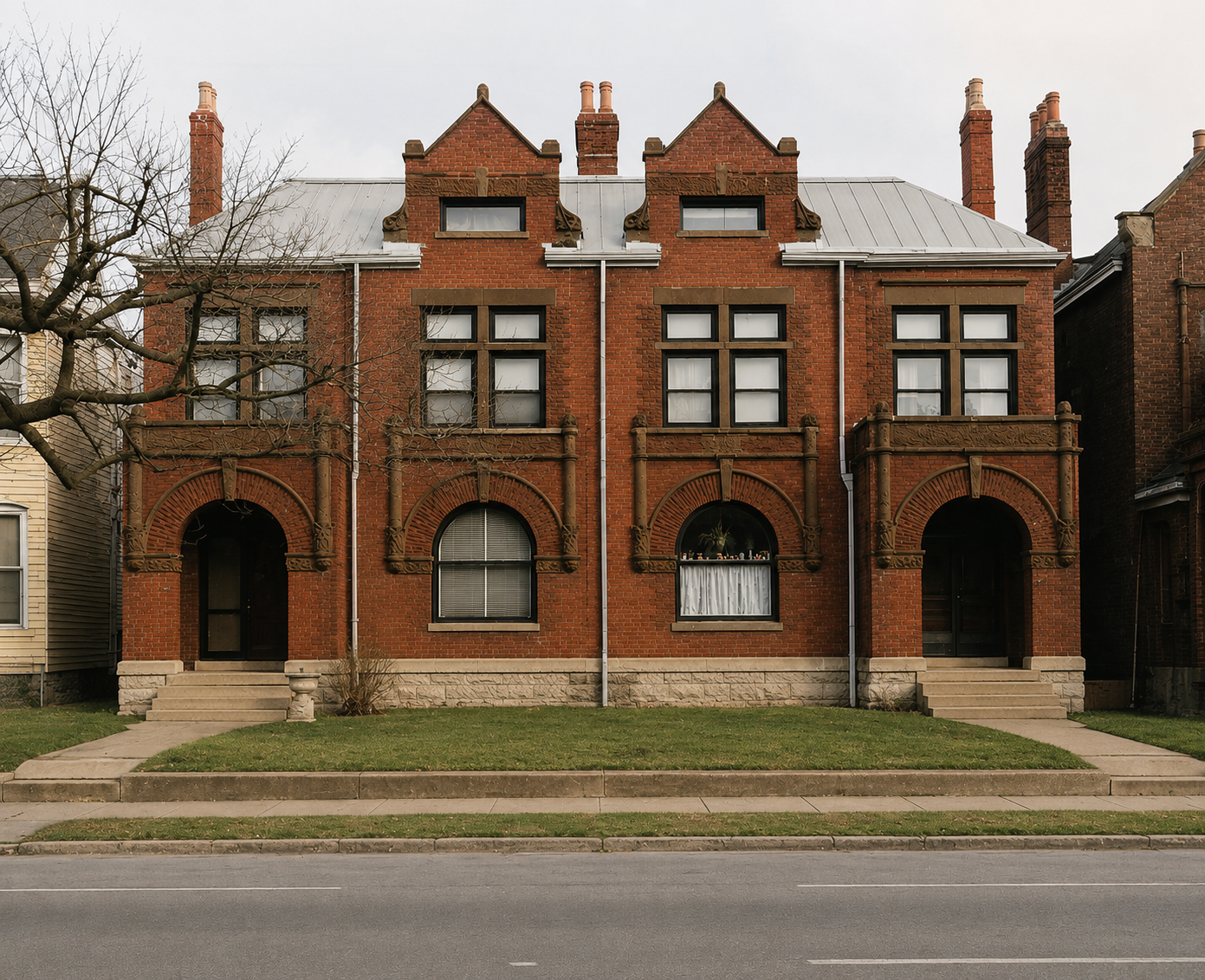
The National Register documentation describes Limerick as an intact late nineteenth- and early twentieth-century residential neighborhood, including a collection of approximately 1860–1870 cottages forming part of the core around which the neighborhood developed.
St. Louis Bertrand Church and parish complex became a focal point of the neighborhood. The district also contains institutions connected to the history of Black education in Louisville.
Its architectural fabric includes modest frame and brick residences, shotgun houses, rowhouses, Victorian residences, and other distinctive building types.
The historical record makes clear that Limerick's story cannot be reduced to a single group, architectural style, or moment in time.
THE ORIGINAL RECORD
Dig into the archives.
The history of Limerick wasn't just remembered. It was documented.
PHOTO DOCUMENTATION
Limerick Historic District Photographs
Historic photographs taken in November 1976 document Limerick's streets, residences, institutional buildings, and parish complex.
Explore the photographs →NATIONAL REGISTER
1978 National Register Nomination
The original National Register documentation records Limerick's historic character, architecture, boundaries, and significance.
View the 1978 archives →LOCAL PRESERVATION
1979 Designation Report
The Historic Landmarks and Preservation Districts Commission's report documents the architectural characteristics and history supporting local designation.
Read the designation report →NATIONAL REGISTER
National Register District Expansion
Documentation for the expanded district captures additional properties and architectural details within Limerick's historic story.
View the 1983 archives →THE DOCUMENTS
Read the record.
Original documents, studies, photographs, and preservation records connected to Limerick's history.
| Year | Document | Type | |
|---|---|---|---|
| 1976 | Limerick Historic District | Historic Photographs | View → |
| 1976 | Mary D. Hill School | National Register | View → |
| 1976 | Mary D. Hill School | Historic Photographs | View → |
| 1977 | Seelbach-Parrish House Landmark Designation | Landmark Documentation | View → |
| 1978 | Limerick National Register Nomination | National Register | View → |
| 1979 | Limerick Designation Report | Local Preservation | View → |
| 1980 | Limerick and The Cabbage Patch | Student Thesis | View → |
| 1980 | Historic Firehouse of Limerick | Historic Photographs | View → |
| 1980 | Historic Firehouse of Limerick | National Register | View → |
| 1981 | Limerick — Yolanda White Paper | Neighborhood Study | View → |
| 1981 | Thierman Apartments | National Register | View → |
| 1981 | Thierman Apartments | Historic Photographs | View → |
| 1983 | National Register District Expansion | National Register | View → |
| 2020 | Girl Scout Project on Limerick History | Neighborhood History | View → |
CHOOSE YOUR PATH
What are you trying to do?
Start with the project or question in front of you.
THE COA ROUTE
How to apply for a Certificate of Appropriateness.
Local historic designation creates a review process intended to protect the character of the district while allowing properties to evolve.
Certificate of Appropriateness Review Process →Review
Review the applicable design guidelines for the district.
Submit
Submit your proposed work through the city's preservation process.
Review
Plans are reviewed by the appropriate preservation staff or committee.
Proceed
Once the appropriate approval is issued, work can proceed.
HISTORIC TAX CREDITS
Financial incentives for preserving the past.
National Register recognition can create opportunities for historic rehabilitation incentives. Qualifying projects must meet the requirements of the applicable program.
These programs also encourage the reuse of existing historic buildings rather than replacing them.
Who to talk to:
Historic rehabilitation tax credit programs are
administered through state and federal preservation
agencies.
STAY CONNECTED
Want to know what's happening in Limerick?
Sign up for neighborhood updates, community news, preservation information, and upcoming events.
Sign Up for Limerick Updates →LIMERICK NEIGHBORHOOD ASSOCIATION